
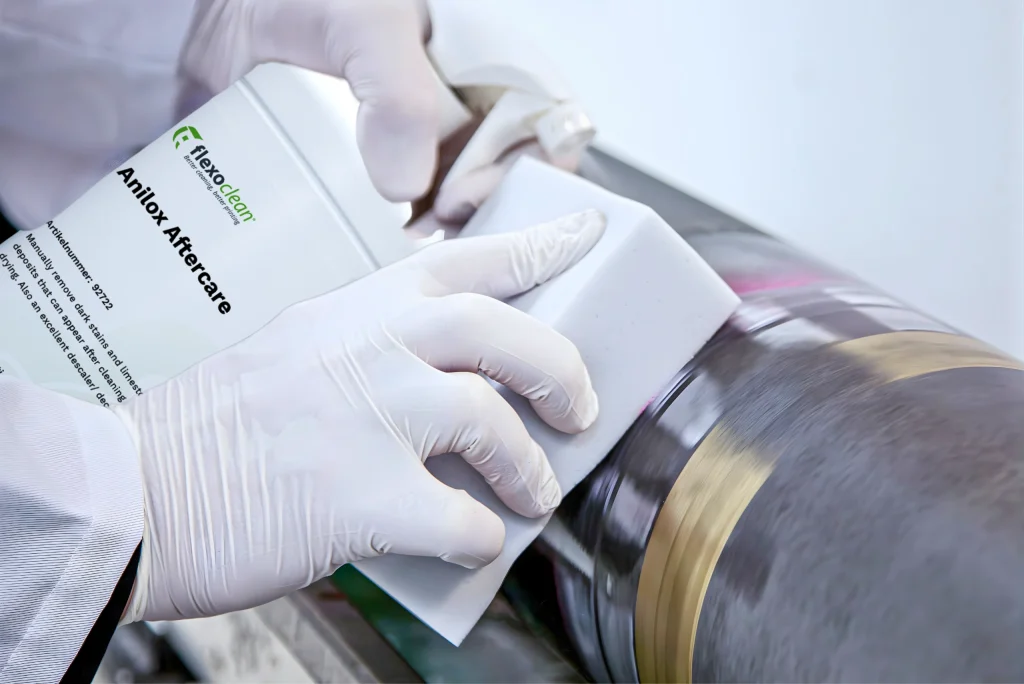
You’ve been running stable print runs for three weeks. Then customers start calling. Subtle color shifts—batch after batch, drifting slightly further from the reference sheet. You adjust the ink settings, but nothing changes fundamentally. Eventually, you measure the anilox: the transfer volume has dropped by 15%. Not due to wear and tear, but because of a buildup of ink residue in the cells.
The anilox never lies. Every percentage point of transfer volume you lose is something you’ve built up somewhere. And you start breaking down that buildup the day you decide how thoroughly you’ll clean.
1. Daily cleaning: Keep your anilox rolls in good condition between jobs
Daily cleaning isn't about thoroughness, but about repetition. Every time you finish a print run, you have a brief window of opportunity: the debris is still loose, the ink hasn't fully cured yet, and the anilox hasn't yet been damaged. That's the moment.
Your daily responsibilities:
- Rinse the anilox rolls after each run
- Empty and rinse squeegee blades and squeegee chambers
- Removing Ink Residue from Pipes
- Visually inspect and clean printing cylinders and printing plates
The right cleaning agent depends on your ink type (water-, UV-, or solvent-based), the surfaces you’re cleaning (anilox roller, printing plate, machine parts, floor), and the presence of aluminum or coated parts, which are not compatible with every product. Flexoclean offers more than 25 specialized daily cleaning agents for all ink systems.

Use the product selector on cleansolutionsgroup.eu or download the free flowcharts to quickly find the right cleaning product for your situation.
Skipping daily cleaning won't save you any time; it will cost you an extra hour during the next setup.
2. Regular cleaning: Avoid having to do a deep clean
Daily cleaning keeps the system running smoothly. Periodic cleaning removes what builds up over weeks: ink pigments deep within the cell structure, varnish in hard-to-reach corners, and deposits in heated ink systems that you can’t see but can feel in your color values.
When should you perform periodic cleaning? Once every four weeks on average is a reasonable guideline, but it depends on actual conditions. If you run a lot of short jobs, make frequent stops and starts, or print with UV or high-solid inks, you’ll need to clean more frequently. If you run stable, long jobs with thorough daily cleaning, you can extend the interval.
The most reliable approach is condition-based: cleaning should be based on measurement results, not on a fixed schedule. Visual inspection (loss of gloss, streaks), quick measurement tools such as the Ravol, or 3D measurement with the Anicam provide objective evidence of cell volume. If the measurement deviates from the baseline measurement, immediate action is warranted.
Additional reasons for periodic cleaning: hard water with limescale buildup, starch in corrugated cardboard, UV or high-solid inks, or additives that cause faster buildup. In these cases, heated cleaning (40–50 °C) works best.
The approach depends on what you encounter.
Manual and targeted treatment:
Clean Solutions Group offers specific Flexoclean periodic cleaning agents for tiger stripes, limescale, starch, coatings, and mixed ink environments. Which product is right for your situation depends on your ink system and the nature of the contamination.
Use the product selector on cleansolutionsgroup.eu or download the free flowcharts to help you choose the right product.
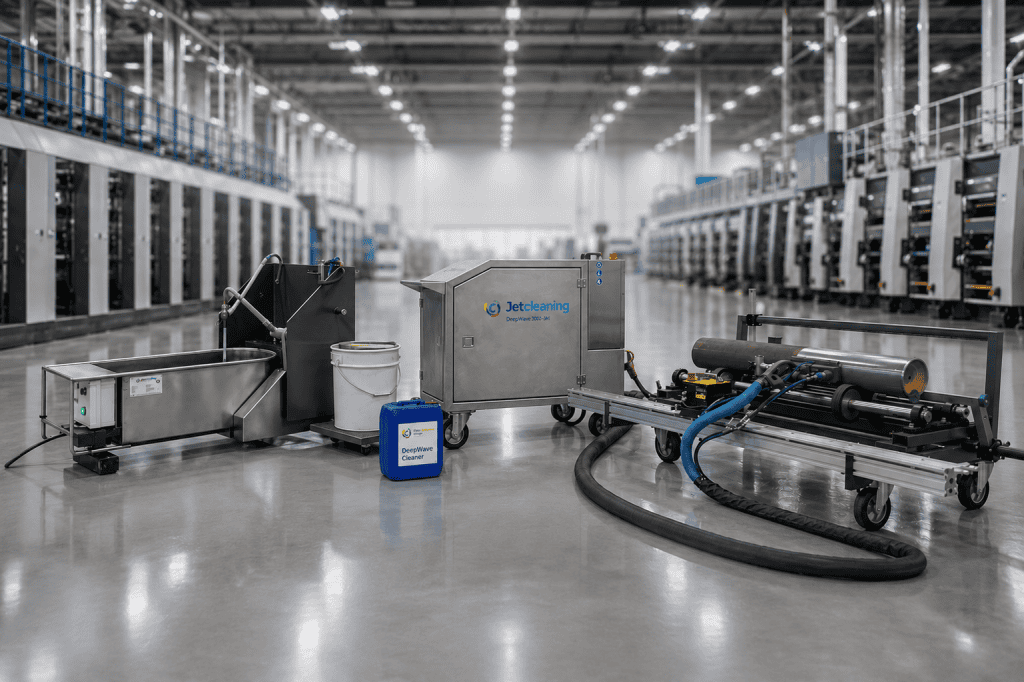
In-line maintenance without disassembly:
- Heating Bucket with Anilox Periodic Special: heats the cleaning solution circulating through the ink pump, anilox, doctor blade chambers, and pipes; effective up to 1500 LPI; no machine adjustments required
Whether online or offline, for the more demanding recurring challenges:
- DeepWave with DeepWave Cleaner and DeepWave Descaler: dual-chemistry system—alkaline for ink residues and acidic for limescale—cleans using chemistry, mechanical force, time, and temperature; primarily for corrugated cardboard
If you perform your daily and periodic cleaning consistently, deep cleaning will remain an exception.
3. Deep cleaning: the last resort
Deep cleaning is not a scheduled maintenance task. It is a last resort. The condition of the anilox roll determines when you need to take action, not a fixed schedule. If you put off daily and periodic cleaning for too long, contamination will build up. The result: longer cleaning cycles, higher costs, and downtime that you could have prevented.
When deep cleaning is needed, there are three cleaning machines you can use:
- BioJet In-Press: automatic deep cleaning, both in-line and off-line, using sodium bicarbonate at 3 bar, approximately 35–45 minutes, no disassembly required
- BioJet Cabinet: offline deep cleaning in a sealed cabinet, sodium bicarbonate blasting at 3 bar, approximately 35 minutes
- Jet-Flow: offline deep cleaning for multiple anilox rolls simultaneously; rubber rollers keep the heated cleaning fluid active within the cells, up to 1000 L/cm, approximately 10–20 minutes
Don’t have your own deep-cleaning equipment or rollers that need to stay in the press?
Clean Solutions Group also offers roller cleaning services: at your location or at our own facility at
.
In-house: At our own facility, we combine mechanical, chemical, and thermal cleaning down to the cellular level, even for high lineatures of up to 1,000 L/cm. This includes measuring and reporting the cell volume before and after cleaning, as well as advice on cleaning frequency and product selection.
On-site: Our experts will come to your location and clean the anilox rolls either inside or outside the press. This service is available during scheduled maintenance shutdowns or in the event of urgent quality issues.
Overview: The Cleaning Routine
Daily and periodic cleaning together make up your routine. Deep cleaning is not a regular part of the routine, but rather a measure taken when the condition of the rollers requires it.
| Level | When | Products / Machines |
| Every day | After each job | 25+ products for WB, UV, and SB – see the product selector |
| Periodically | Every 4 weeks | Manual: See product selector / Heating Bucket / DeepWave |
| Deep | When cell volume is compromised | BioJet In-Press, BioJet Cabinet, Jet-Flow |
The Benefits of a Consistent Cleaning Routine
Printing companies that clean consistently on a daily and periodic basis see consistent results:
- Fewer unexpected downtimes due to contamination issues
- More consistent color values and reproducible print results, job after job
- Longer service life of anilox rolls and printing cylinders
- Shorter setup times for new print jobs
- A predictable maintenance schedule instead of putting out fires
Cleaning is not an expense, but an investment in production stability. A consistent daily and periodic cleaning routine keeps the need for intensive and costly deep cleaning at bay and keeps your printing process under control.
Would you like to know which cleaning program is right for your machine and production?
Our specialists are happy to work with you—on-site, right at your own machine. Schedule a consultation and walk away with a concrete cleaning plan.