Ever since Flexoclean’s early days—about 30 years ago now—cleaning has been our core focus: no anilox rolls, no ink, no presses. Instead, we provide the resources, expertise, and support that make cleaning effective—from cleaning agents and dosing systems to on-the-shop-floor training. That focus on cleaning has remained unchanged for decades. The way we put it into practice has, however: our product range has grown over the years, but our core mission has not.
An approach that existed even before the market demanded it
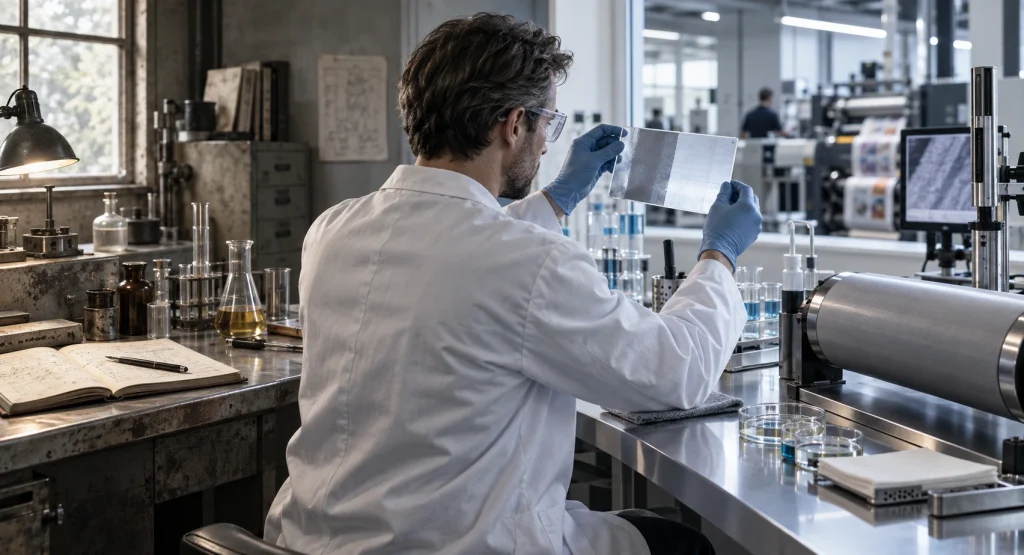
Right from the start of Flexoclean, we tested customers’ inks in our own laboratory using our cleaning agents to determine which agent was most effective for that specific process. We provided advice on daily and periodic cleaning—both inline and offline—and offered training and support on the production floor. Volume measurements of anilox rolls were standard practice from the outset—not something that was added later.
In other words: the essence of what we now call the Cleaning Performance Cycle—through which we address product, process, and behavior collectively—was already inherent in how Flexoclean operated decades ago. The cycle formalized that approach and expanded it using the principles of Total Productive Maintenance; it did not reinvent it.
A formula that has proven itself in the market
A cleaning agent that keeps more cells open, remains effective longer, and is gentle on the roller itself isn’t developed in a single year. It is the result of decades of continuous testing and refinement, in the real-world settings of print shops that rely on it every day.
The clearest proof of this doesn’t come from us. Other players in the market now have us manufacture their own cleaning products under private label. A company doesn’t make that choice just for the sake of a good story, but because the product demonstrably works—even when it doesn’t bear our own name.
Cleaning as a system, not as a single action
Cleaning only yields sustainable results when product, process, and behavior are addressed together, rather than in isolation. We have translated this principle into the Cleaning Performance Cycle, which is based on the principles of Total Productive Maintenance.
At its core is a cleaning culture: cleaning that is embedded in our daily work practices, rather than a task performed on a whim. Our benchmark against comparable plants in the packaging and printing industries shows the benefits this brings:
- Consistent cleaning: stable, repeatable results instead of ups and downs.
- Longer service life for anilox rolls: less wear, fewer replacements.
- Better print quality: clean cells, fewer rejects.
- Demonstrable cost savings: for a factory with 4 production lines, we estimate savings of €1.1 to 1.2 million per year, due to reduced downtime, lower energy consumption, and fewer external deep cleans.
By way of comparison: at an average corrugated cardboard factory, the production value lost due to unplanned downtime can easily amount to €1.5 to 2 million per year. A large portion of this can be directly attributed to cleaning processes that are not systematically organized.
The position we take
Cleaning deserves a central place in the maintenance strategy, not just a side note. That was the guiding principle on which Flexoclean was founded decades ago, and it is the guiding principle upon which the Cleaning Performance Cycle continues to build today.
Wondering what that means specifically for your own production process?
Request a 15-minute consultation with one of our experts. During the consultation, we'll work together to identify where you can increase your profits.
- More information about the Clean Performance Cycle? Click here for more details.
- More information about the cleaning routine? Click here for more details.