
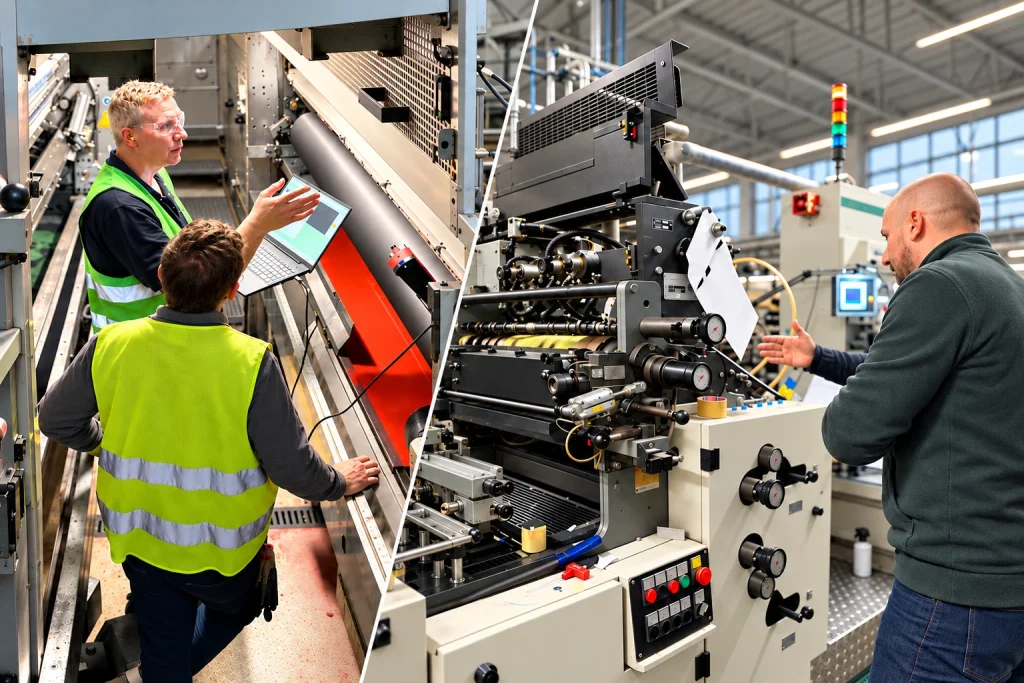
The question Mark (R&D) is always asked about cleaning anilox rolls when he’s on a service call at a corrugated cardboard factory is: Will we be able to clean them less often in the future?
Everyone at the table expects the answer to be yes. The plant manager, the production manager, and usually the buyer who has joined them.
And almost always, I have to say, “No.”
More often.
That rarely goes over well. You're sitting across from someone who just explained that his people already don't have enough time, and then you go and tell them they have to take on more work.
That's why these days I start by telling them what happened with a similar client.
They cleaned more often and spent less time doing it
A leading corrugated cardboard manufacturer asked us to visit their facility to identify where their cleaning process was taking up production time. The results were contrary to what they had expected.
Don't clean any less often. Clean more often, but for shorter periods.
What was eliminated was the deep cleaning. It went from four times a year to once every year and a half.
“We’ve started cleaning more often, and that’s exactly why we almost never have to deep clean anymore. On balance, it takes us less time—not more.”
Why Cleaning More Often Saves Time
There are three ways to clean an anilox roller, and each method serves a different purpose.
- Daily: briefly, after each run, so that dirt doesn't build up.
- Periodic: weekly or monthly, for cell volume and ink transfer.
- Deep: the most intense round.
If you don't do the first two, that intense round is your only defense.
And that's the crux of it. Removing contamination on the same day takes just a few minutes. The same contamination that has been there for three months requires a scheduled half-day shutdown.
What I’d most like to show people is what happens in between. As long as that contaminated layer is in the cells, your ink transfer rate drops. It doesn’t show up as a malfunction. It shows up as a startup that takes a little longer and a color that fluctuates a little longer—and then it happens again every shift.
What else changed for them
Deep cleaning was removed from the weekly schedule.
And the operators now know when to do what—and why. To be honest , I think that second point is more important than the first. A routine that people don't understand will last a month at most.
What I'm looking at
It's not just about the press. I look at four things: people, machines, methods, and materials.
That sounds like a model, and it is. But in practice, those four are interconnected. Here’s an example I often see:
- The cleaning solution isn't compatible with the ink. That's a material issue.
- That means one round isn't enough, so there will be a second round. That's the method.
- Every team approaches that second round a little differently. That's just human nature.
- And whatever remains gets lodged in the cells of the anilox roller. That's how the machine works.
I've seen factories that simply replaced the cleaning agent. In the second round, the differences between the shifts and the contaminated roller remained. After a few months, the problem returned.
Where to Start
We've laid out the four areas mentioned above on paper, in the form of a worksheet, with two questions per area. We'll fill this out together. It'll take no more than 15 minutes.
Next, choose three points, and decide on a first step, giving it a name and a date.
If you'd like to know how long production will take for you, Mark—or Mark 😉—from our R&D department will come by to take a look.