TPM*-Driven Cleaning

Six hundred hours of unplanned downtime. Year after year.

An average corrugated cardboard plant loses about 10 percent of its scheduled production time due to unplanned downtime. With 6,000 operating hours, that amounts to 600 hours per year. A large portion of this is due to cleaning, which is recorded under various categories such as malfunctions, changeovers, and maintenance.

* Total Productive Maintenance

Calculation Example

600 hours × €2,500 production value = €1.5 million per year

Replace €2,500 with your plant's hourly production value.
cleaning performance cycle wheel simple

10%

of the planned production time is lost to unplanned downtime

±600 hours

lost production per year based on 6,000 operating hours

26

Recurring bottlenecks identified in benchmarks at flexographic and corrugated cardboard plants

THE APPROACH

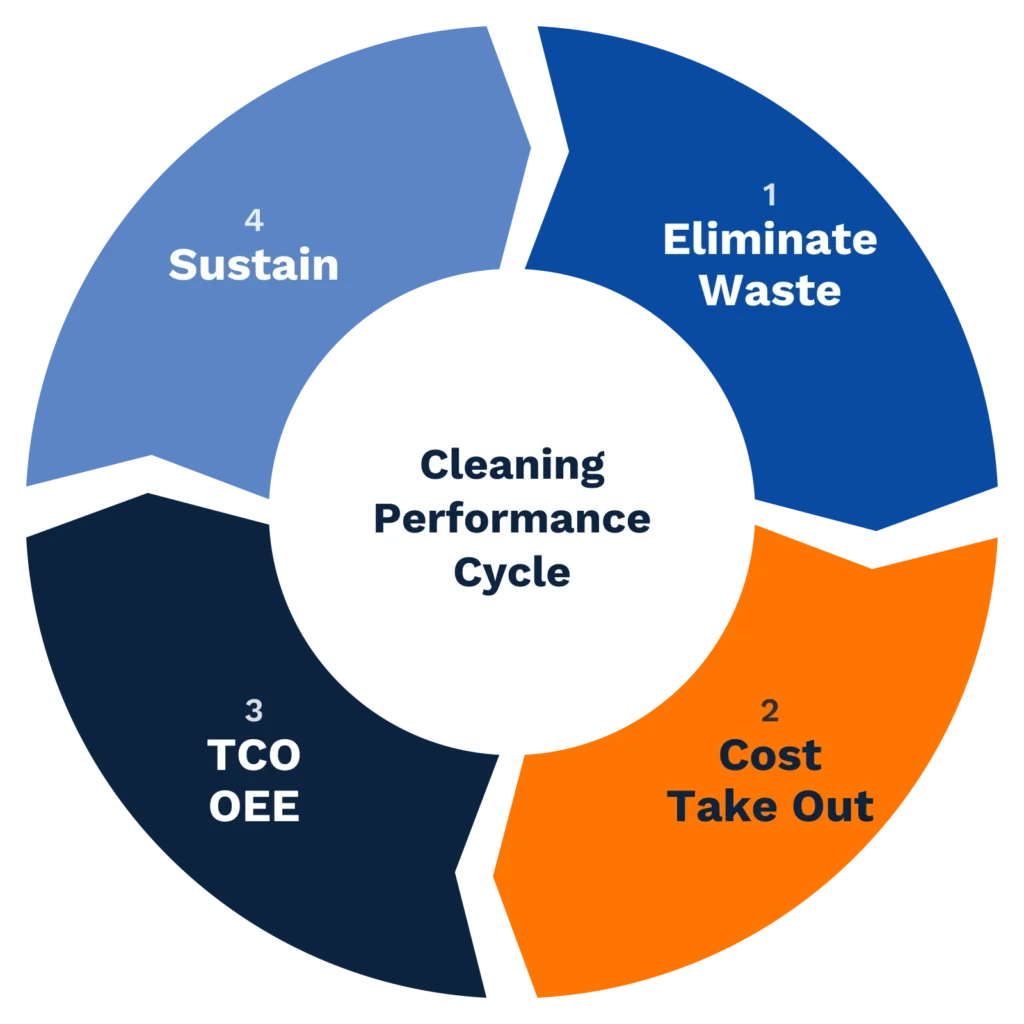
The Cleaning Performance Cycle

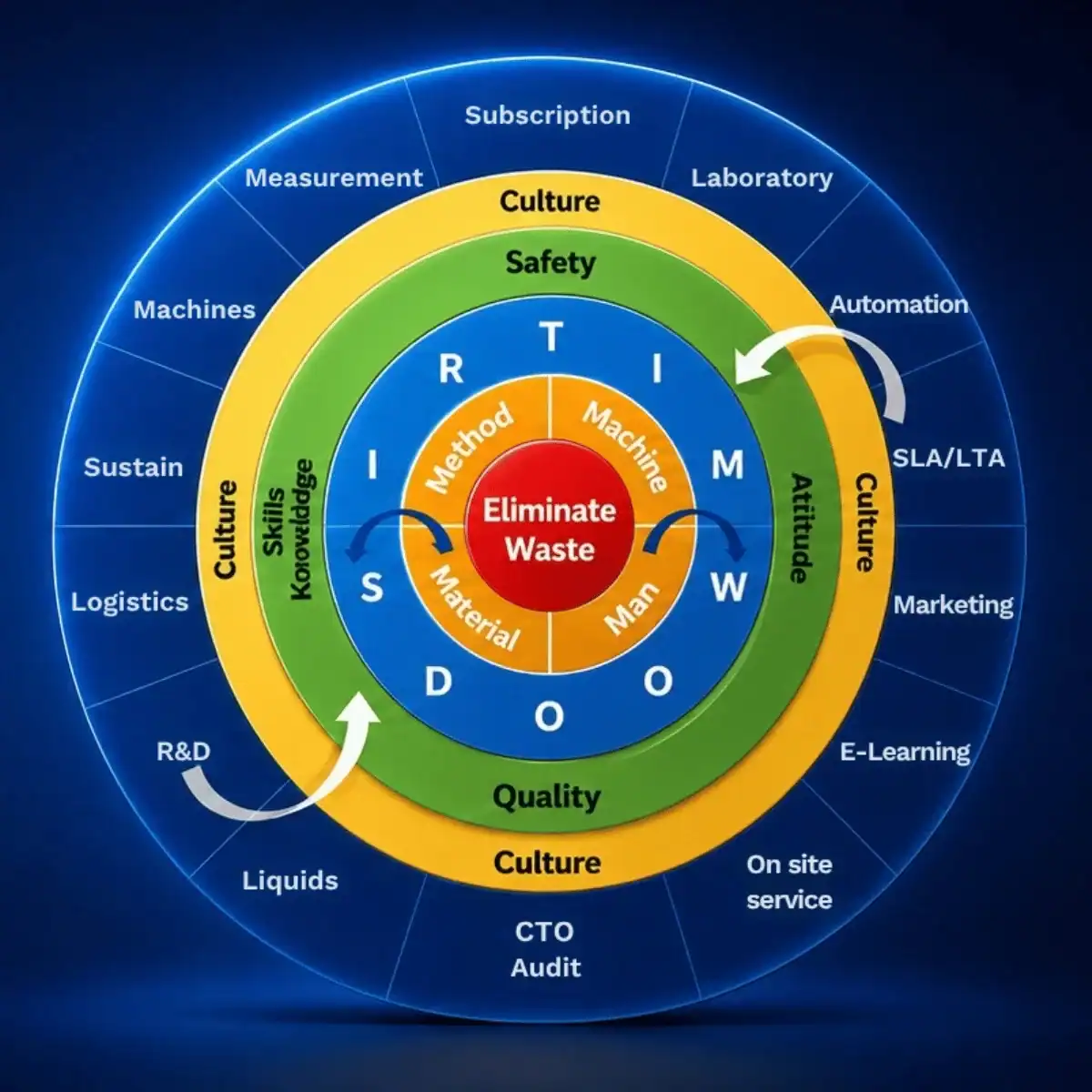
Four root causes, ten forms of waste, and 26 critical junctures. The cycle reveals where time, quality, and capacity are lost, and recovers those losses step by step.

Step 1

Eliminate Waste

Step 2

Cost Takeout

Step 3

TCO and OEE

Step 4

Sustain

Click on the wheel to enlarge it.

The Orange Ring: The 4 M's

Machine

Technical condition, settings, availability, and maintenance.

Method

Procedures, cleaning frequencies, work arrangements, and process design.

Human

Knowledge, training, communication, and implementation.

Materials

Inks, cleaning agents, substrates, and other materials.

The Light Blue Ring: SIR TIM WOOD

Ten forms of waste, ranging from transportation and inventory to rework and underutilized skills. Where a cause and a form of waste intersect lies the greatest opportunity to reduce losses in a targeted manner.

THE WASTE MATRIX

Find out what bottlenecks exist in your plant

The matrix links the 4 M’s to the ten forms of waste. Click on an orange plus sign for a detailed practical example, or on a green dot to see what that bottleneck might mean for your plant.

Detailed example, available for immediate viewing Challenge identified in the benchmark Not applicable
Drag the matrix to the side to see all ten columns.
Transport
Stock
Exercise
Waiting Period
Overproduction
Overprocessing
Defects
Skills
Revision
Information
Machine
Materials
Method
Human

Click on an orange plus sign to see a fully worked-out example. Click on a green dot to see what that bottleneck might mean for your plant.

The amounts in the examples come from different plants and should not be added together: bottlenecks often share the same cause.

FROM INSIGHT TO ACTION

Two regular routines. Deep cleansing less often.

Daily and periodic cleaning together make up your preventive maintenance routine. If you perform both consistently, print quality and machine performance will remain stable for longer, and you’ll be able to postpone costly deep cleaning for as long as possible.

Every day

Give it a quick cleaning after each run to prevent dirt from building up.

Periodically

Weekly or monthly, focusing on cell volume and ink transfer.

Deep

Planned and controlled, and—thanks to a set routine—needed as rarely as possible.

WITH A SET ROUTINE

1 scheduled deep cleaning every year and a half

WITHOUT A SET ROUTINE

4 deep cleanings per year, plus unpredictable downtime

CASE

Why a globally operating corrugated cardboard factory has actually started cleaning more often

We’ve started cleaning more often, and that’s exactly why we almost never have to deep clean anymore. On balance, it takes us less time—not more.

Deep cleaning was removed from the weekly schedule. Operators now know when to do what—and why.

NEXT STEP

From an exploratory meeting to an improvement plan

Introductory Meeting

An overview of your production process, cleaning routine, and key challenges. Free of charge.

Cost Take-Out Audit

If there is sufficient potential for improvement, the audit provides a comprehensive overview of cleaning procedures, downtime, and work methods.

Concrete Improvement Plan

Routines, resources, priorities, and the expected savings potential, all in one practical plan.